Learning Hub > Flagging Review Content
Twenty-five minutes on why consumer reviews are protected, what the FTC rule requires of you, what our moderation team actually does, and how to read every flag reason before you use one. Built for the people who touch reviews daily.
Honest consumer feedback sits on protected ground. Regulators treat writing fake reviews and suppressing real ones as two sides of the same deceptive practice. That framing is the reason moderation exists, and the reason it has limits.
1
Reviews are not removed for being negative. A one-star review that follows the rules stays up, full stop.
2
Scrubbing legitimate criticism misleads shoppers. It is the behaviour consumer-protection rules were written to stop.
3
Shoppers convert on a profile they believe. A page of only glowing reviews reads as fiction to them.
“ResellerRatings is a passive aggregation of consumer opinion, and it is our mission to improve the consumer shopping experience by providing a safe, unbiased space for customers to share their experiences.”
Before you Flag · ShopperStream knowledge base
Twenty-five minutes on why consumer reviews are protected, what the FTC rule requires of you, what our moderation team actually does, and how to read every flag reason before you use one. Built for the people who touch reviews daily.
Honest consumer feedback sits on protected ground. Regulators treat writing fake reviews and suppressing real ones as two sides of the same deceptive practice. That framing is the reason moderation exists, and the reason it has limits.
Reviews from people who do not exist, who never used the product, or that misrepresent the reviewer's experience. Buying, selling, or writing them is prohibited.
Officers, managers, employees, and agents must disclose the relationship. Solicitation from relatives and staff carries its own requirements.
You cannot present a site or entity you control as an independent source of reviews about your own category.
No unfounded legal threats, physical threats, intimidation, or false public accusations to get a negative review removed. No implying your review display is complete while negative reviews are held back because of their sentiment.
§ 465.7 · the one that touches flagging - Review suppression
Why moderation is still allowed
The rule draws its line at sentiment. Withholding reviews is not suppression when the criteria are applied equally to every review regardless of whether it is positive or negative, for reasons such as vulgarity, discriminatory content, personal information, or content unrelated to the business.That is exactly what the flagging terms are: sentiment-blind rules, applied by a team that does not know or care what star rating is attached.
What that means for your desk
A flag needs a sentiment-neutral reason. “It is one star” is not one.
Never threaten a reviewer, or our team, with legal action to move a review.
Employee and affiliate reviews need disclosure, which is why that flag exists.
Asking a satisfied customer to update a resolved review is fine.
Conditioning anything on the sentiment is not.
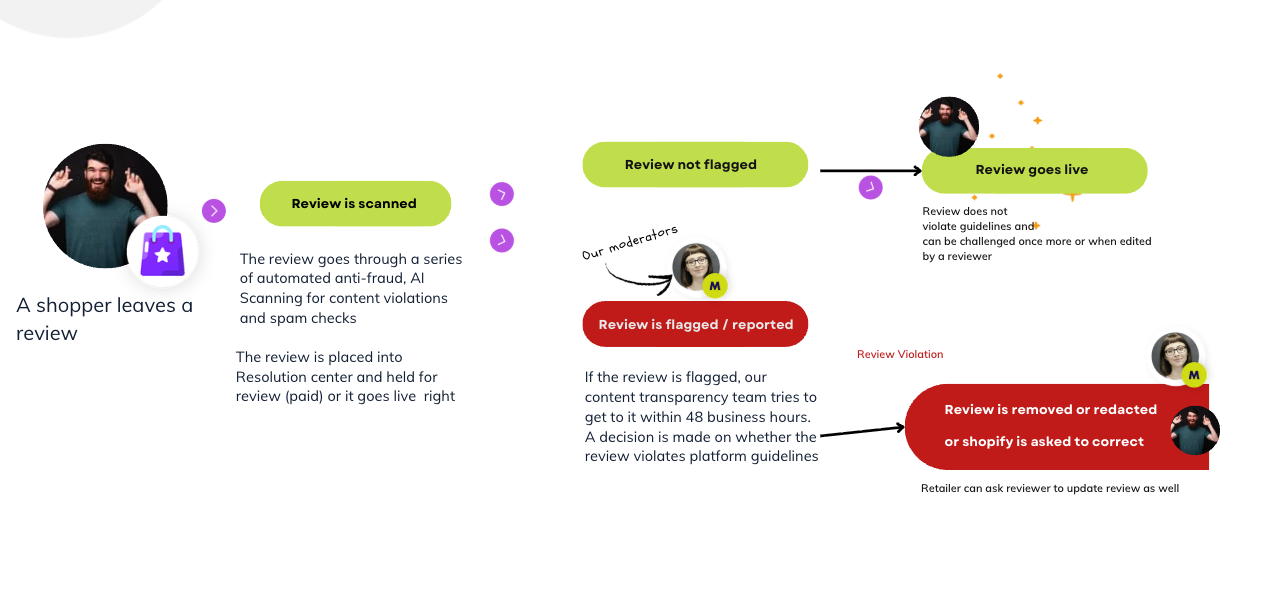
Every submission passes automated anti-fraud and spam checks. Content that gets escalated goes to the Transparency Team, trained people who read the review against published terms and aim to decide within 48 business hours.
Flag
A retailer-only tool. It puts the review in a queue that is judged strictly against the flagging terms, so it needs a term to point at.
Report
Available to any user on the site. Sends the review to the Transparency Team for a general look, including things like copyrighted material.
The Transparency Team
People, not a filter. Each flagged review is read manually.
Works Monday to Friday, 9am–5pm ET. with legal action to move a review.
Targets 48 business hours; two business days at the outside.
May go back to the reviewer or to you for detail or clarifiying situations.
If the only problem is that you see the events differently, the tools that help you are direct message and public reply. Future shoppers read the exchange, and a calm, specific reply does more for your reputation than a missing review ever could.
Neither we nor you can prove what happened in someone's living room. Message them first, then reply publicly with your side. If there are terms or a statement that is material to the review and proven to be false then it will be removed. However the bar and standard here is high and must be consequential to the review.
You can ask the reviewer to update it. If they decline, the review stays, because resolution is not a terms violation. The resolution itself is worth saying out loud in your reply.

Covers language that crosses community-standard lines — obscenity, threats, harassment, slurs, or defamatory statements presented as fact.
The review contains obscene or excessively profane language, threats of violence, targeted harassment, discriminatory slurs, graphic depictions of harm, or personal attacks against staff.
Negative tone, anger, frustration, sarcasm, or criticism on their own. A harsh one-star review is not vulgar unless it breaks the standards above.
Likely outcome
Least-restrictive first: where a genuine experience can be preserved, only the prohibited language is redacted rather than removing the whole review.
Reviews may not expose information that could identify, contact, authenticate, or locate a private individual.
The review includes full names, personal phone numbers or emails, home addresses, account or order credentials, financial or government IDs, or sensitive medical/personal data.
A first name used respectfully when reasonably necessary to describe the interaction — that is allowed.
Likely outcome
Personal information is redacted while the rest of the review stays visible whenever possible.
A review may mention another business when that reference is reasonably connected to the reviewer’s experience.
The reference primarily advertises another business, includes referral links / coupon codes / contact info, focuses more on the other business, appears intended to divert customers, or presents misleading competitive claims as fact. E.g. “Don’t buy here — buy from XYZ instead.”
Fair comparisons like “shipping was slower than competitors I’ve used” or “I chose another provider for faster delivery.” Those stay.
Likely outcome
Where the third party is relevant, its name may be replaced with a neutral description (“the retailer,” “the delivery provider”) rather than removing the review.
Applies only when objective evidence indicates the reviewer did not have the interaction described. A completed purchase is not always required.
Records show the claimed order doesn’t exist, an invoice belongs to a different transaction, the interaction could not have occurred, or the reviewer admits they never interacted with the business.
A genuine experience without a purchase — browsing, checkout, support chats, delivery attempts, accessibility issues. Don’t use it just because you can’t locate an order or the reviewer used different contact info.
Likely outcome
Verification may be requested when there is a reasonable, specific question about authenticity, rather than immediate removal.
The review should primarily describe a firsthand experience with this business, its site, service, transaction, or fulfillment.
The content focuses primarily on an unrelated business, website, or event, a political/social issue with no connection to the transaction, or a product the business never sold or serviced.
Product-specific comments tied to something the business sold, delivered, installed, serviced, returned, or supported — those remain valid
Likely outcome
Reviews are preserved wherever a genuine merchant connection exists; removal is reserved for content with no meaningful link to the business.
For reviews that publish private or confidential correspondence never intended for public release.
The review reproduces private emails, support tickets, private chats, internal documents, legal communications, or confidential contractual information.
Summarizing a conversation, quoting an ordinary customer-service response, or referencing a public policy — unless confidential, privileged, or sensitive information is actually exposed.
Likely outcome
The confidential portion is redacted where the remainder of the review can stand on its own or the review is removed.
A narrow flag for a materially false representation of an objectively verifiable transaction, published term, or event.
The statement is factual (not opinion), concerns a material aspect of the experience, can be objectively disproven by records or published terms, and substantially misrepresents the transaction — e.g. fabricated charges, a false published return/warranty period, or a provably nonexistent order.
Dissatisfaction with shipping speed, delivery-date disagreements, opinions on service quality or fairness, policy-interpretation disputes, minor inaccuracies, or two parties reasonably reading the same transaction differently.
Likely outcome
Requires specific supporting evidence. General disagreement or an unsupported claim that the customer is wrong is insufficient — the existence of merchant terms alone is not grounds for removal.
For reviews carrying an undisclosed material interest in the business.
The review appears authored by a current or former employee, contractor, affiliate, owner, or other person with a material interest, and the relationship is not properly disclosed.
Genuine customers who happen to speak favorably. Internal employment disputes and workplace feedback belong in other channels, not consumer reviews.
Likely outcome
Undisclosed conflicts of interest may be removed; enthusiasm from a real customer is not the target.
A review is not automatically invalid just because a third-party carrier was involved.
The complaint concerns only an independent carrier and has no meaningful connection to the retailer’s own conduct.
Cases where the retailer selected the carrier, managed fulfillment, handled packaging/tracking/replacement, or where the retailer’s response to a delivery problem was part of the experience.
Likely outcome
Where the carrier reference is incidental, the review may be redacted or redirected rather than removed.
Age alone does not automatically invalidate a review.
The experience occurred more than 12 months before submission and its relevance or accuracy is genuinely in question.
Legtimate issues for product or services failure on older purchases, where geninuine interactions may have happened closer to failure
Likely outcome
Removed only when the passage of time makes the review materially misleading or impossible to validate.
Content may be restricted when it demonstrably violates the law, a valid court order, privacy or IP rights, platform safety requirements, or this policy.
There is a demonstrable violation — e.g. defamation, a privacy breach, or an IP violation — with the specific challenged content and the basis for the claim identified.
A general statement that a review is false or harmful. Tariffs, duties, and broader economic conditions are not standalone grounds for removal.
Likely outcome
Claims must identify the exact content at issue; the separate Tariff flag is being retired.
A perceived mismatch between the written review and its star rating is not ordinarily grounds for removal.
Rarely — a reviewer may express mixed sentiment or intentionally rate differently from how the merchant reads the text.
Ratings you simply disagree with.
Likely outcome
Deprecated as a standalone flag. Technical safeguards now reduce accidental rating errors automatically. If any issue exists - the reviewer will be reached out to first to correct or clarify.
Customers may submit more than one review when each concerns a separate purchase or distinct experience.
The same reviewer repeatedly posts about one experience, the content is materially identical, or duplicates are spread across feeds/accounts to manipulate ratings or visibility.
Separate, genuine reviews for different purchases or experiences — those are allowed.
Likely outcome
Duplicates are consolidated with at least one legitimate version kept visible, rather than removing all.
Patterns get noticed. A queue full of flags on negative reviews with no term behind them reads as an attempt to shape the record, and it changes how your account is treated.
An audit of the account, re-reviewing flagged content going back a set period.
Repeated misuse can put a visible notation on your public review profile.
ResellerRatings reserves the right to stop working with any party that consistently abuses the moderation tools.
Legal threats aimed at the Content Transparency Team are not tolerated and may prompt further action or reporting abusive behavoir to the FTC
Once the Transparency Team has adjudicated a review, it is conclusively reviewed and can only be flagged once more - alongside context review like uploaded documents supporting claims. The other exception is a review the author has since modified.
Do not re-flag. Email support@resellerratings.com and walk through the specific case.
Flagging every one and two-star review as a matter of routine.
Picking a reason that roughly fits so the form will submit.
Re-flagging a decision you did not like.
Flagging every one and two-star review as a matter of routine.
Name the term out loud before you open the flag form.
Quote the offending issue in your note to the team.
Reply back to the customer first and help resolve the issue and THEN ask them to revise
Full policy detail lives in the knowledge base: flagging terms, before you flag, what to expect after you flag, and how to flag a review.
Read Flagging TermsGoogle Seller Ratings | Product Reviews | Q&A | Insights & More
See Solutions


